

It happened in Taboga Island, Panama. I remember the menu well—white, with faded watercolor flowers. An old man, around seventy, brought it to us. His eyes were bluer than the sky, set against sun-creased skin.
He greeted us in perfect English and warned us that all he had left was tea. “Tea it is,” I said. Soon, he brought out worn cloth napkins and a small white porcelain dish filled with sugar.
Tiny black ants began climbing up, emerging from the cracks in the wooden table. I blew and blew to chase them away. Frustrated, I got up to tell our host about the ants.
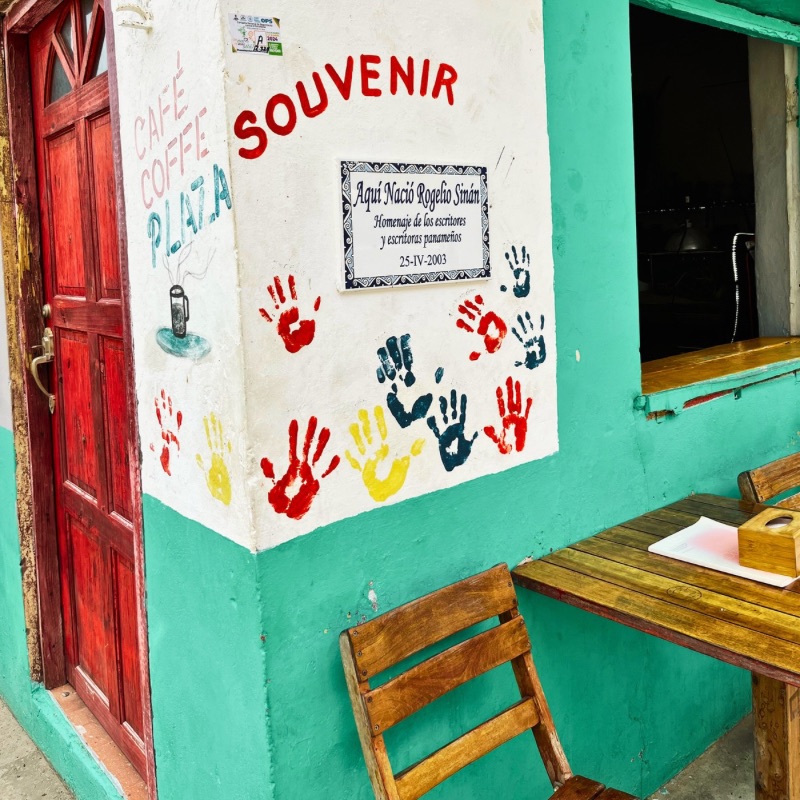
But I stopped when I saw him, so focused on the blue teapot that I couldn’t bring myself to speak. I watched as it sat atop an electric burner. The windows had no glass—just open frames revealing a world within: an old typewriter, scattered sheets of paper, cups lined up in a row, guitars hanging on the wall. A bed with exposed springs and other objects hard to identify. A sepia-toned scene, with an old man at its center.
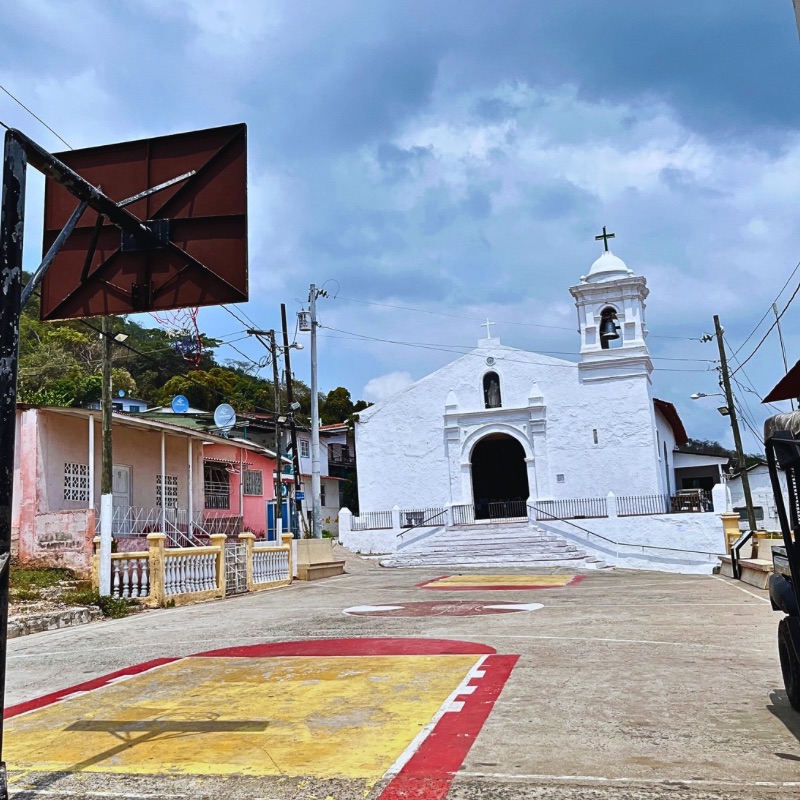
I returned to the table. John gestured behind me. We hadn’t noticed it before—a small white church standing across the tiny concrete plaza we had just crossed. John gazed at it.
“Buenas tardes,” a voice carried through the air. A family passed by, two children playing. The three of us responded, “Buenas tardes.”
The old gringo was already pouring water into delicate, timeworn tea cups. He placed a small dish on the table, holding six packets of cinnamon and jasmine tea, then hurried off, returning with a couple of cookies.
I asked where he was from. “I’m Panamanian,” he replied. Seeing my husband’s reaction, he elaborated—born in Panama to American parents stationed here in the 1950s.
As a child, his family returned to the U.S., where he grew up and built a life. But thirty years ago, in the ’90s, he said, he came back to Panama. Just like us, he one day visited Taboga Island. He walked it from end to end. Then, he sat in one of the chairs at this very café.
And in that moment, he told us, a quiet happiness settled over him—the kind that stays with you. His eyes landed on a sign that read For Sale, and something clicked into place. Now, as he recounted it, that happiness felt both timeworn and fresh. He knew then that he had come home. “The real one,” he said.
My cookie was as sweet and delicate as a polvorón. And I remembered that some joys dissolve realities, leaving behind only the scent of jasmine.
Somehow, this old gringo left us with traces of his happiness. And he suddenly reminded me of Carlos Fuentes’ novel Gringo Viejo. Maybe that’s why I took the liberty of calling our host Gringo Viejo.
This story is based on our visit to Café La Plaza on Taboga Island, March 19, 2024.
