A Corner Turned, a Century Found: Meeting the Pfister House in Colmar

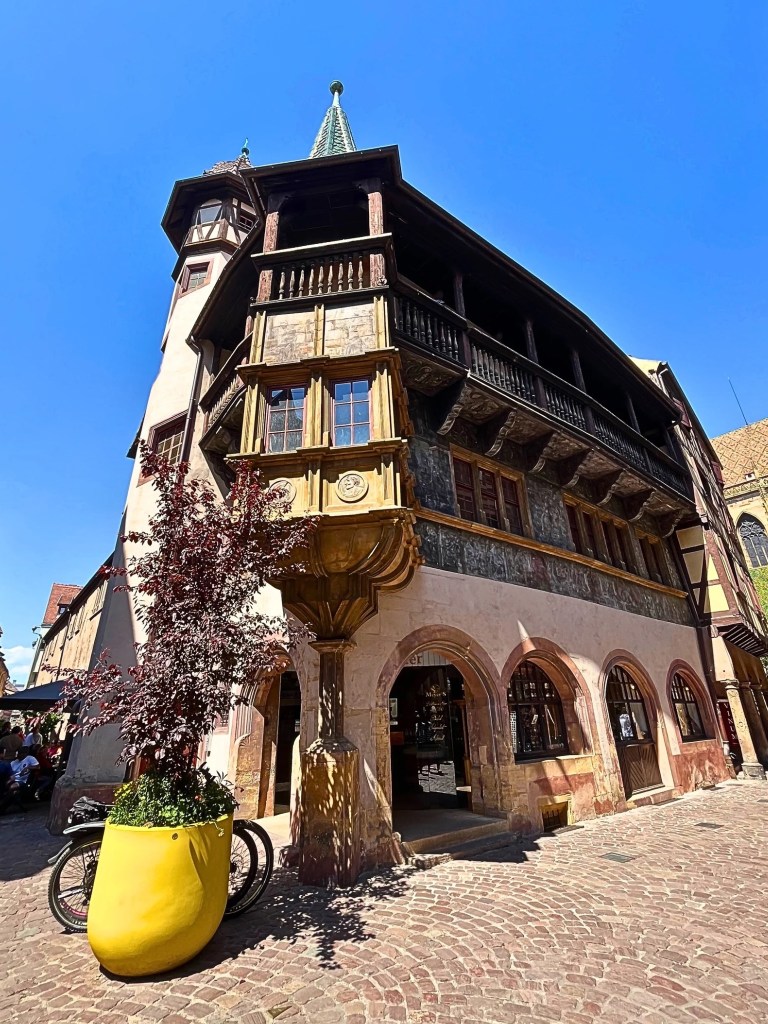
A dramatic upward shot of the Pfister House in Colmar, France, highlighting its Renaissance architecture with a turret, oriel window, timber balcony, and a vivid yellow planter in the foreground.

I wasn’t planning to find the Pfister House. I was just walking through Colmar on a quiet Thursday morning—May 1st. The streets were still sleepy, shutters half-closed, and the light had that soft, early spring glow. Then I turned a corner, and there it was—tall, golden, and full of stories. It almost felt like the house was leaning forward, as if curious about the people passing by.

Built in 1537 by a wealthy hatter, this house isn’t just beautiful—it’s full of character. There’s a wooden oriel window that juts out into the street, decorated with carved faces and faded paintings. You can still see the outlines of old murals on the walls, like echoes from another time. Up top, a green-tiled turret points to the sky, catching the sunlight just right—like something from a fairytale.

Standing in front of it, I felt both small and big at the same time. Small, because buildings like this—survivors from a world I can’t even imagine—remind you how tiny you are in the long story of life. And big, because you’re here, alive, witnessing it. That morning, as a breeze moved through the old beams and a bike rolled past, I felt lucky. Like I had stumbled into a little moment of magic that had been waiting for me all along.
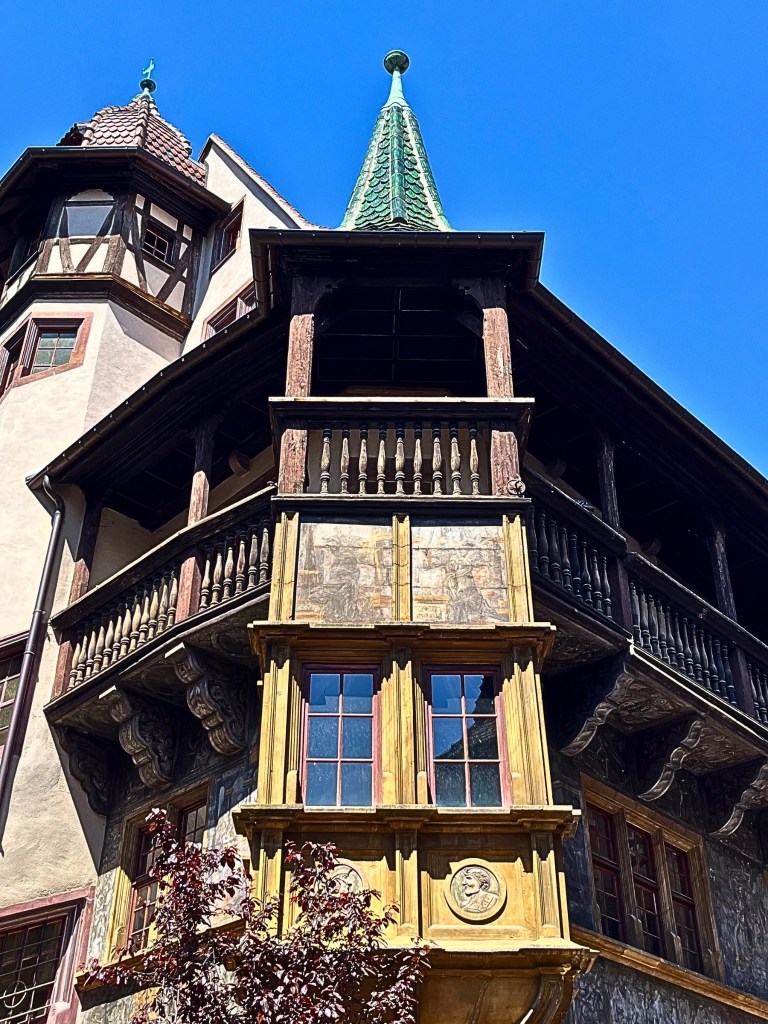
A close-up view of the Pfister House in Colmar, focusing on its golden ochre polygonal oriel window, ornate wooden panels, carved medallions, faded mural paintings, wooden loggia, and turreted roofs, all against a cobalt blue sky.
The Pfister House whispers centuries of history through its golden oriel window, weathered murals, and towering turrets, where Gothic spires meet Renaissance warmth.
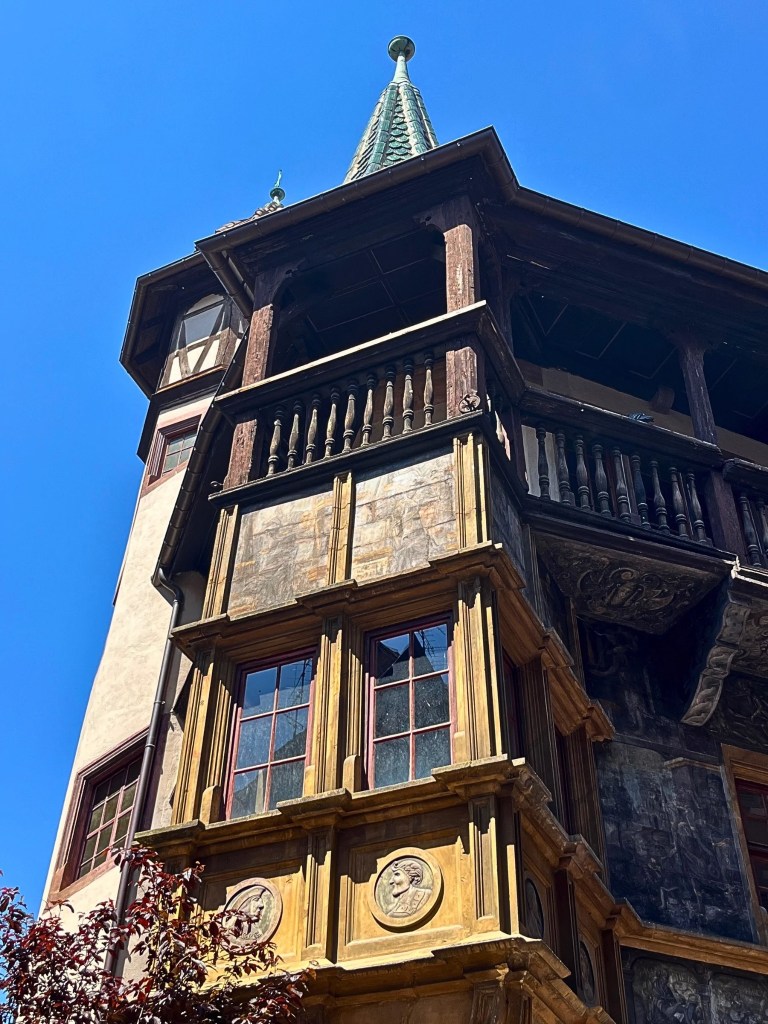
Upward-angled photo of the Pfister House in Colmar, France, showing a honey-colored oriel window, faded Renaissance murals, a wooden loggia, and a green-tiled turret under a clear blue sky.
Tilt your gaze skyward in Colmar, and the Pfister House greets you like a Renaissance fable carved in wood and stone—its golden oriel, faded frescoes, and tiled turret all whispering of a time when architecture was both storytelling and showpiece.
A view from the ground showing the contrasting architecture of the Pfister House on the right and a salmon-colored half-timbered house on the left, set against a clear blue sky.
Two distinct architectural styles meet in Colmar’s picturesque streets: the elegant Pfister House and a cozy salmon-hued half-timbered home, framed by the endless blue sky above.
A cobblestone street, Rue Schongauer, with the Pfister House on the left and a gothic building at the end, under a bright blue sky.
This view of Rue Schongauer in Colmar showcases the cobblestone street, with the ornate Pfister House on the left. At the end of the street, a gothic building rises against the clear blue sky, completing this picturesque scene.
A dramatic upward shot of the Pfister House in Colmar, France, highlighting its Renaissance architecture with a turret, oriel window, timber balcony, and a vivid yellow planter in the foreground.
Where history leans skyward—Colmar’s Pfister House rises like a Renaissance dream, its turret brushing the blue, its carvings whispering tales five centuries old.
The Pfister House! Wander the cobblestone streets of Colmar, where history breathes, inviting you to pause.

During our visit to Colmar in the Alsace region of France this May, we strolled through the charming streets, where history seemed to whisper at every turn. One of the highlights was the stunning Pfister House, a masterpiece of 16th-century architecture. If you’re curious to learn more about this fascinating piece of history, join me in exploring its story further.

For a glimpse into Spain’s vibrant culture, be sure to explore my snapshot stories from the Iberian Peninsula.