
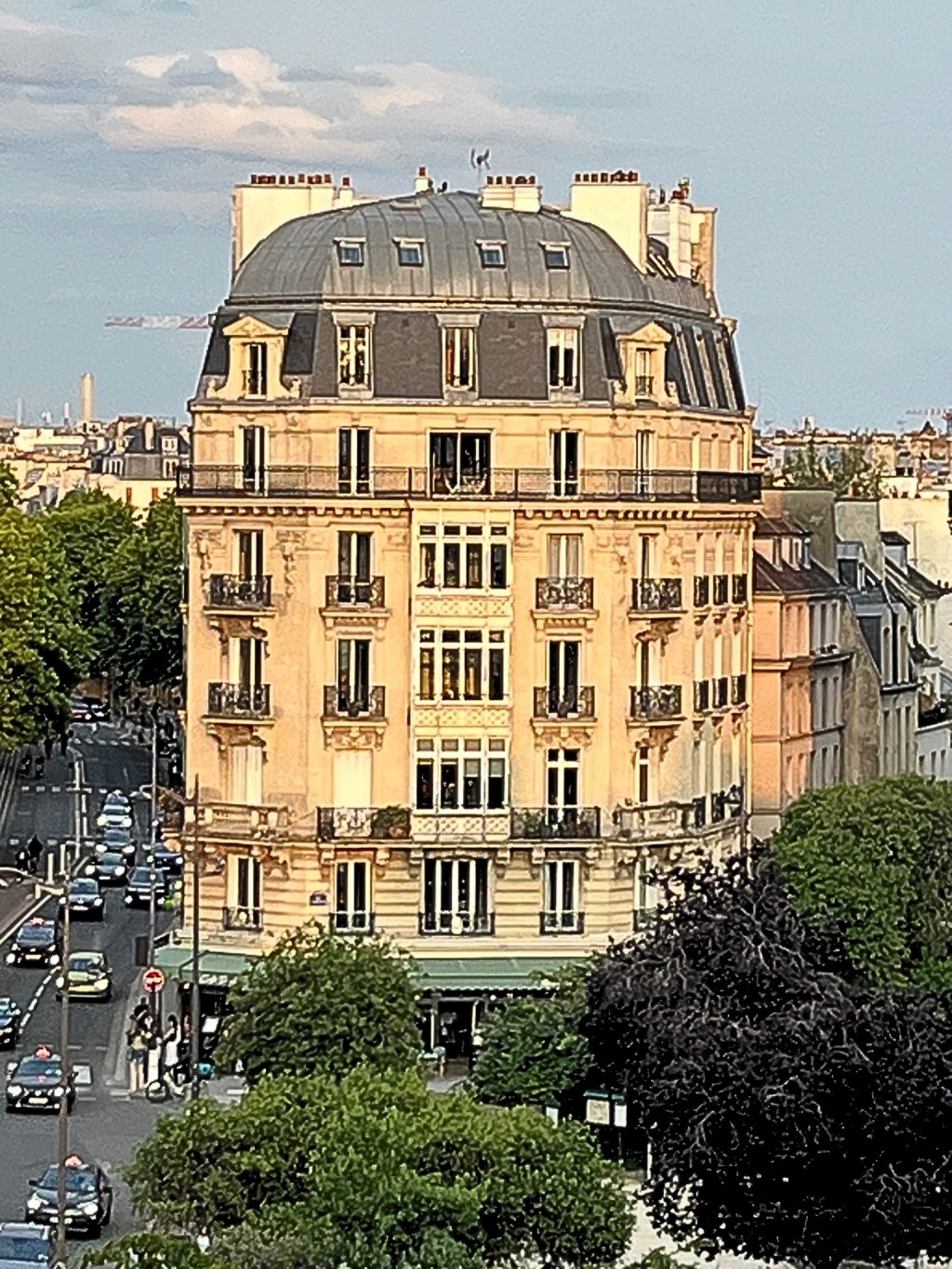
The magic of this view cast a spell on me for five unforgettable days. From the Juliet balcony of my hotel room, I checked off the most cherished item on my bucket list. Each morning, I sipped tea while gazing at that scene. And every night, just before bed, I paused to admire its luminous glow. It was Notre Dame, the streets, the architecture. It was the ceaseless hum of Paris. It was the quiet joy of knowing I was there—standing before one of the most vibrant, beautiful corners of France: Quai Saint-Michel and Rue du Petit Pont.

The Heartbeat of Paris in Sunlight, Stone, and Story
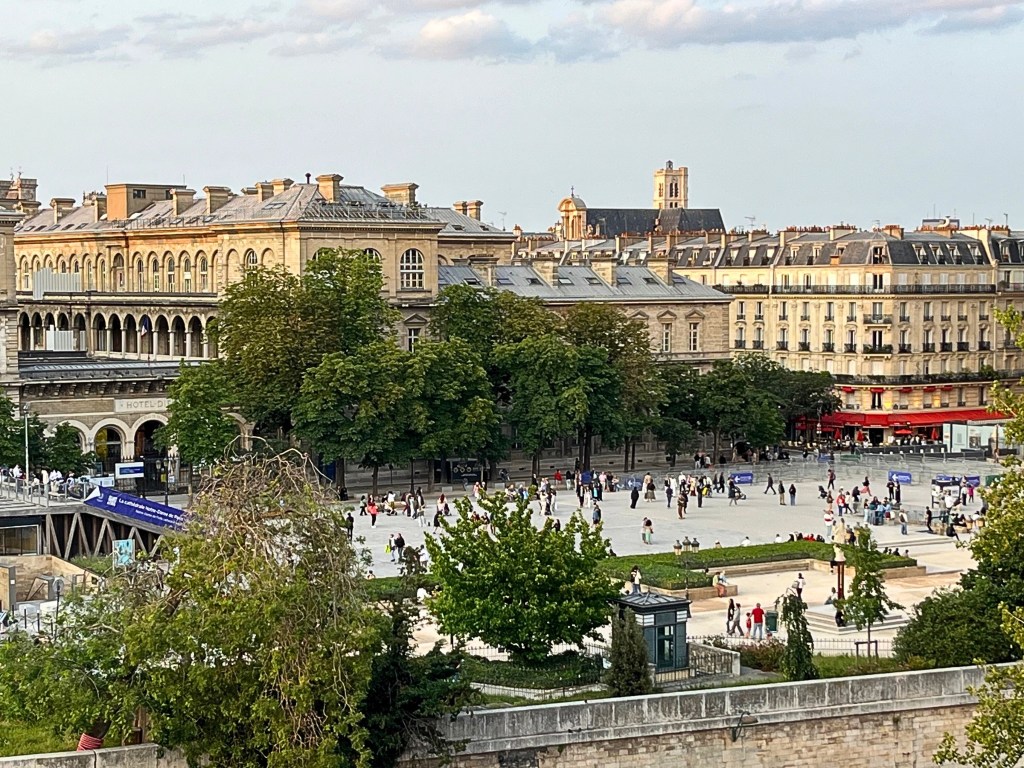
Looking out from the balcony, the city arranges itself like a painting. To the left, behind the treetops, sits the Hôtel-Dieu de Paris—the city’s oldest hospital, founded in the 7th century. Its 19th-century façade is stately and symmetrical, with rounded archways at street level and a long upper loggia supported by Corinthian columns. The creamy stone glows in the afternoon sun, lending the building a golden stillness that softens its institutional roots. Though massive, it feels at ease here—part of the island’s architectural cadence.
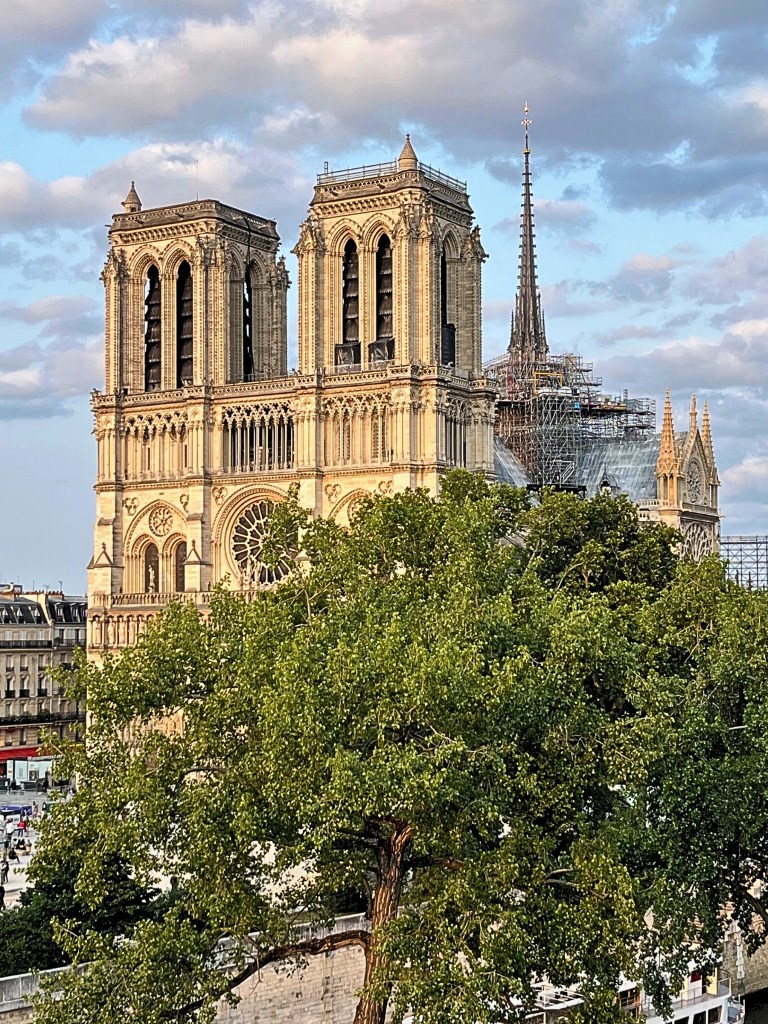
Just beside it, the western façade of Notre-Dame de Paris rises into view, now open and welcoming again. Bathed in warm, late light, her twin towers hold the sky with quiet power. The sculpted rose window between them doesn’t sparkle with glass but with carved stone that catches the light like a held breath. From this angle, the cathedral feels not just monumental, but alive—each detail catching its own piece of the sun.

At the foot of the cathedral lies the Parvis de Notre-Dame, a wide square that draws people in. You see them scattered along the edges—sitting on benches, photographing the towers, or simply standing still, watching. The design of the square is clean and geometric, with tidy flowerbeds and clipped hedges guiding the eye without overpowering the space. Right at its center lies Point Zéro des Routes de France, a small brass marker on the ground, almost hidden among footsteps. All roads in France begin here, symbolically—yet it feels anything but symbolic in that moment.

Beneath it all flows the Seine. The river curves gently to the right, catching the fading light in soft flashes. Along the tree-lined quay, boats are moored like floating lounges—places where people lean back, sip wine, and let time pass. The island’s edge is peaceful, but not silent. You hear footsteps, laughter, and the shuffle of leaves in the breeze, all folding into the river’s quiet rhythm.

In the foreground, the Le Petit Pont café anchors the corner with cheerful charm. Its bright yellow and green awning is impossible to miss—a sunny contrast to the mellow stone of the buildings around it. The terrace is full of life: clinking glasses, drifting smoke, conversations that meander. Beside it, more cafés stretch out beneath red awnings, creating a colorful patchwork of tables and voices along the block.
And if you keep looking just a bit further down the street, toward the far right of this lively block, you’ll catch a glimpse of the green awning of Shakespeare and Company. The famous bookstore feels almost tucked in, humble despite its legacy. Between the facades, the trees, and the people pausing in golden light, the whole view becomes a layered story—one of stone, sunlight, and city life suspended in a perfect Parisian hour.
In the Heart of Paris, We Stand Still—Held by Light and Memory
This corner of Paris—where Quai Saint-Michel, Rue du Petit Pont, and the Île de la Cité meet—has witnessed more than a thousand years of history. It is one of the city’s oldest hearts, layered with centuries of memory: from medieval markets and royal processions to revolutions, occupations, and jubilant liberations. For Parisians, it is sacred ground, where the stones remember what the books sometimes forget. This is where Paris began, and in many ways, where France still looks to find its soul.
To stand here, simply watching the light move across the buildings, is to feel history without needing to explain it. We come from all over the world, drawn not only by beauty but by something deeper—something like belonging. Though we weren’t there when the stories were made, we are part of them now, just by being here. To witness this view is to be reminded how civilization calls to us, across time and distance, and how lucky we are to listen.
This reflection was inspired by our visit to Paris in June of 2025, a time when the city’s light seemed to slow just enough for us to notice its quiet splendor. From our balcony above Quai Saint-Michel, we glimpsed the soul of Paris—layered, luminous, and alive. If this view stirred something in you, I invite you to explore more of our moments across France, where every walk reveals a story, and every corner holds a trace of enchantment.
